Showing posts with label Archbishop Polding. Show all posts

22 July, 2026

New Prayer Card


In diebus illis
This new card is presently being prepared for publication.  It commemorates the holy lives of Benedictine bishops John Bede Polding and his coadjutor, Charles Henry Davis.

The card has been approved for publication by the Bishop of Maitland & Newcastle, Most Reverend Michael Kennedy.


Artwork copyright of the Saint Bede Studio.


Bishop Charles Davis


25 April, 2026

Archbishop Polding writes about war

On this Anzac Day, we are pleased to post this letter which Archbishop Polding wrote to the Faithful of the Archdiocese of Sydney in 1856, noting and asking them to give thanks for the conclusion of the Crimean War.  Although few residents of Australia would ever have seen the Crimea, nevertheless a volunteer force of cavalry, artillery and infantry was formed in and around Sydney and travelled to the Crimea to fight as part of the British Army.  The Crimean War would largely be forgotten now, except for two things : the famous Charge of the Light Brigade during the Battle of Balaclava; and the heroic work of the English nurse Florence Nightingale "The Lady with the Lamp".  The Archbishop makes reference to the nurses working with Florence Nightingale in the following letter.


Officers and men of Her Majesty's 13th Light Dragoons.
These men were some of the survivors of the Charge of the Light Brigade.
Photographed in 1855 at Balaklava by Roger Fenton.


Dearly Beloved Children in Jesus Christ,

A mighty war has ceased! We have to speak to you of these good tidings. You have already heard and welcomed them – the most joyful news of restored peace. Already, from every worthy heart, the spontaneous outburst of gladness and gratitude has gone forth in congratulations to your fellow men, in thanksgiving before the throne of God. A mighty war, unexampled for its costliness in blood and in treasure, has come to an end. May it have accomplished what is the only legitimate end of war : the security of peace! At this distance from Europe, we have been spared the horrid spectacles of murderous contest; few of us have had to don the sad garb of mourning for the loss of friends and dear relations crushed to death in the miserable strife; but yet, in that United Kingdom which is our common fatherland, to which we still attach the endearing name of home and in the fair realm of noble France, how many hearths lie desolate! How many victims have been sacrificed! And with these sufferings, with these bereavements, we have been constrained to sympathy by the ordinary feelings of humanity, by the charity of the common heart of Christendom. 

Florence Nightingale c. 1858
It is most true, that in the midst of great griefs springs up great consolations; this is God’s gift of compensation by which He deduces good from the dreariest evil. If we have witnessed carnage and mortal agony, we have also been called to honour the greatness of self-devotion and the heavenly endurance of charity. Young men – young solders – who may have taken up their profession, it is like enough, with very inadequate thoughts about it, have been ripened by the stern exigencies of their service, into the deliberate martyrs of duty. Death-beds have been painful and sad enough; and yet, have they not been tended and lightened during this war by the assiduity of the priests of God, whose profession of self-sacrifice was gloriously realised? And by the gentle courage of those heroic women who, some of them marked and honoured in their generation (and many more un-noted in their work, and therefore the more like their Lord), passed from sufferer to sufferer in the busy offices of Christian pity and love? Thank God for these bright and grand spectacles, and thank God also that the necessity of them is over. May we be the men of good will from whose hearts and lives in this renewed peace on earth shall ascend glory to God in the highest.

But, Dearly Beloved, these natural emotions, allowable and even laudable, are simply the occasion which, we trust, will awaken graver thoughts in your minds. … War is the teacher which impresses on the minds of nations, faith in the presence of God. The discipline of our individual lives trains us in the conviction that God is the last end of our respective souls and the collective sufferings of warfare prove to nations that their final cause is not to be sought in any temporal object. Let us then now accept this lesson of Providence. If men in truth desire the salvation of their souls and peace upon earth, consider whether unrestrained indulgence in the sensuous comforts of peace, and the hard-hearted insensibility to the sufferings of fellow-men, which is its unfailing attendant; whether security and pride as the fancied architects of their own fortunes; whether their all-absorbing care for the temporal, and their little anxiety for the spiritual; whether their self-glorification in national prospects, and their few thoughts for the Church of Christ throughout the world, may not have been the last drops in that brimming cup of iniquity which the Almighty Lord of Heaven and Earth has been punishing by war. And if the same causes are at work amongst us, may not similar effects follow? 

The Village of Balaklava with the British Fleet at anchor in the harbour.
Photographed in 1855 by Roger Fenton.


But thank God the war is over … It is over and it is well, if we learn His lesson.  Bearing it in mind, rejoice, Dearly Beloved, but rejoice in the Lord always; let your gladness be tempered by a reverential filial fear.  Holy, holy, holy is the Lord God of Hosts.  He is merciful, but He is also holy, and holiness cannot forever spare the impenitent.  May the blessing of our dearest Lord, the Father of the world to come and the Prince of Peace, abide with you forever. Amen.

+John Bede Polding DD 
Archbishop of Sydney.


NOTES

1. Extracts from Archbishop Polding's Pastoral Letter commemorating the conclusion of the Crimean War as contained in the anthology The Eye of Faith. The Eye of Faith was printed by the Lowden Publishing Co., Kilmore Victoria in 1977.  

2. The Crimean War, which was waged in various theatres between 1853 and 1856, resulted in the deaths of a quarter-of-a-million soldiers. An alliance of British, French and Ottoman forces was arrayed against Russia over its attempt to enlarge its Empire and take control of the Black Sea.  A good summary of this bloody conflict can be read here

3. An extraordinary collection of photographs taken in 1855 at the Crimea by the English solicitor-turned-photographer Roger Fenton may be consulted at this website.


AMDG

21 April, 2026

The beginnings of the Church in Australia :
a brief sketch 1792 - 1834

In previous articles at In diebus illis, we have traced the beginnings of Christianity in the Colony of New South Wales.  We noted the numbers of Catholics who were part of the First Fleet in 1788.  We read a heartfelt letter from an English Catholic priest, asking to be allowed to travel to Botany Bay to minister to Catholic convicts.  We also gained a vivid glimpse into the ministry of the first Christian Chaplain to the Colony, the Reverend Richard Johnson.

The purpose of this article is to give an overview of the events and personages of the Catholic community in the Colony of NSW from 1792 until 1834, the moment when Australia's first bishop, John Bede Polding OSB, was appointed.  For this overview, we use material from the Australian Dictionary of Biography and from some Catholic historians.   EN1   The contents of this post will be elaborated upon with forthcoming articles.  A further article will discuss the varying social conditions of Catholics during the first fifty years of the Colony.

As we have traced in previous articles, the spread of the Gospel was not a focus of the early Governors of the penal colony of New South Wales, still less, support for the practice of Catholicism.  There was no practical interest in religion per se, except as a means of improving the moral tone of the Colony - a struggle which was ongoing.  The absence of any formal Catholic community in Australia before the arrival of the two Catholic chaplains in 1820, also reflected the lack of legal rights afforded Catholics in Britain and the suspicion which British Authority had towards the blend of Irish Nationalism and Irish Catholicism.  Although the largest proportion of Catholic felons transported from Britain and Ireland from 1788 were Irish, not all were and there were also a small number of soldiers and officials of the Colony who were Catholic.  In 1792, a group of Catholics resident in Parramatta petitioned the Governor of NSW to make some provision for the religious sensibilities of Catholics; unsurprisingly, it was ignored, but this was the first moment when Catholics asserted their desire to practise their Religion.

Following the 1798 Uprising against British Rule in Wexford on the west coast of Ireland, many more Irish Catholics were transported to New South Wales and among them were three priests, Fathers JAMES HAROLD, JAMES DIXON, and PETER O'NEIL.  All three were accused - unjustly - of complicity in that Uprising.  They have been known to Australian history as The Convict Priests. The fortunes of these these three in the Colony varied somewhat, and it was only Father Dixon who was was given official permission to offer Mass publicly in 1803. Rome conferred on him the title of Prefect Apostolic of New Holland, which sounded very grand, but had very little benefit to the Catholics of the Colony.  

Father Jeremiah O'Flynn
A sketch which appears in 
The Progress of Catholicity in Australia
published 1886.
What seemed the beginnings of a Catholic community collapsed when discontented Irish convicts took up arms at Castle Hill (near Parramatta) in 1804.  Even though Father Dixon attempted to broker peace between the Castle Hill rebels and the Colonial Authority, Government toleration of Catholicism evaporated and the ministry of Father Dixon came to an official end.  All three priests had left the Colony by 1810, without any permissions granted for a further public ministry.  Seven bleak years ensued when there was no Catholic priest resident in the Colony, and yet, there were prominent Catholics - mainly former convicts - who worked quietly and successfully at building up a Catholic community.  We mention here William Davis and his wife Catherine (nee Miles), Jane Langley, James Dempsey, Michael Dwyer, James Sheedy, Michael Hayes, Edward Doyle, James Meehan, Catherine Fitzpatrick and her family.  

The essential distrust of Irish Catholics held both by the British and successive New South Wales Colonial governors, was not eased by the short ministry in Sydney of the Irish priest, JEREMIAH O'FLYNN.   Father O’Flynn, formerly a Cistercian monk, arrived in Sydney in 1817 with Rome's approbation as Prefect Apostolic.  Always given to imprudence and impetuous behaviour, Father O'Flynn failed to obtain prior approval from the British Government to enter and minister to Catholics in the Colony.  When he arrived - unannounced - he was not made welcome by the Governor, Lachlan Macquarie.  Father O'Flynn assured Macquarie that authorisation for his appointment would be forthcoming from London, but without licence, he ministered in semi-secrecy to the Catholics of Sydney and surrounding districts.  He was eventually arrested and deported by Colonial Authorities to England.  He left behind a Catholic community disheartened by the loss of their pastor, but also a Divine present : the Reserved Sacrament in a pyx guarded reverently in the home of one of the pioneer Catholics of Sydney. 

The notorious case of Father O'Flynn had other significant outcomes so far as the Catholic Community in the Colony was concerned. Upon his return to Britain, there was public distaste for the manner in which Fr O'Flynn had been treated, but perhaps more concern was expressed for the plight of Catholics in the far-off colony who had no chaplain.  Pressure brought to bear on the Government made them more disposed to providing Catholic chaplains, but they also cooperated with Catholic Authorities in Rome and London to facilitate this.  The British Government's continuing unease about Irish Catholicism led them to cooperate with the Vicar Apostolic of London in arranging for a chaplain or chaplains to be sent to NSW.  

Father John Joseph Therry
An aquatint of him painted in
Ireland around 1815.
In 1818, Rome created an Apostolic Vicariate ( a form of Diocese) at the Cape of Good Hope and responsibility for the Catholics of far-off New South Wales was entrusted to the new Vicar-Apostolic, English Benedictine FATHER EDWARD BEDE SLATER. The new bishop's jurisdiction included Mauritius, Madagascar, the Cape of Good Hope, New Holland and Van Diemen's Land. Notwithstanding the British Government's intentions that English Catholic priests be sent to NSW, the incapacity of the English Benedictines to send priests to the outposts of this vast ecclesiastical territory caused Bishop Slater to seek chaplains in Ireland. Two Irish volunteers, Fathers JOHN JOSEPH THERRY and PHILIP CONOLLY, were accepted by Bishop Slater OSB and appointed by the British Government, each with a salary of £100. These two priests were to be the Bishop's missionaries in New Holland and Van Diemen's Land. They were responsible both to him and to the Colonial Government. The two chaplains arrived in Sydney in May 1820.  

Embarking on their work with great enthusiasm, unfortunately it became clear very quickly that the two priests did not work well together.  In 1821, within months of the pair's arrival in Sydney, Father Connolly left the mainland to establish a mission in Van Diemen’s Land, specifically in Hobarton, where the small Catholic population was almost entirely convict.  Father Therry was left to minister to the needs of Catholics in all the existing and newly-settled areas of NSW.  Despite his immense energy and missionary zeal, he was barely equal to the demands upon him.  Although admirable for his perseverance in adverse circumstances, his hot-headedness and impatience with Authority led to his too-prominent association with groups opposed to Colonial policies.  A series of aggravating incidents led to the withdrawal of his Government salary in 1826, and a determined effort to expel him from the Colony.  

Father Therry would not be moved, however, and continued his ministry whilst being supported by the Catholic Faithful, who held him in the highest esteem.  Partly because of their regard for him, the Catholic community did not warm greatly to the two Irish priests who replaced Fr Therry in succession as Chaplain from 1826.  These were  FATHER DANIEL POWER and then FATHER CHRISTOPHER VINCENT DOWLING OP.  Notwithstanding these divisions, the priests continued a zealous ministry.  In 1821, the first Catholic school in Australia commenced in Parramatta and the foundation stone of the first Catholic Chapel - subsequently known as Saint Mary's - was laid by no less a personage than Governor Macquarie.

Father John McEncroe
Arrived as a Catholic Chaplain
in 1832

From the late 1820s, as the number of Irish Catholics in the colony continued to rise (though mainly convicts and working class people), a trickle of educated and politically-significant Irishmen migrated to Sydney, notably ROGER THERRY and JOHN HUBERT PLUNKETT, both of whom were appointed to senior legal offices in the Colony.  FATHER JOHN McENCROE accompanied Mr Plunkett as an additional official chaplain (1832).  Father McEncroe, who had previously spent some years working in the American colonies, managed what his two predecessors (Fathers Power and Dowling OP) had failed to do, namely to maintain a good working relationship with Father Therry.  

In the same year, 1832, a new Vicar Apostolic at the Cape of Good Hope appointed FATHER WILLIAM BERNARD ULLATHORNE OSB (a monk of Downside Monastery in England) as his Vicar-General in the colony of New South Wales.  This appointment was ratified by the British Government.  Although very young, when Father Ullathorne arrived in Sydney in 1833, he tactfully and capably put the affairs of the Church in order with the assistance of Father McEncroe and sometimes grudging cooperation from Father Therry.  But Father Ullathorne soon saw the infant Church in Australia needed its own resident bishop, and wrote to Rome and England accordingly.  After some consideration and negotiation, the Holy See and the British Government reached agreement and FATHER JOHN BEDE POLDING, another Benedictine monk of Downside Monastery, was appointed the Vicar Apostolic of New Holland and Van Diemen's Land in 1834.
-o-o-o-o-o-o-o-o-o-o-o-o-o-o-o-o-o-o-o-o-o-o-o-o-o-o


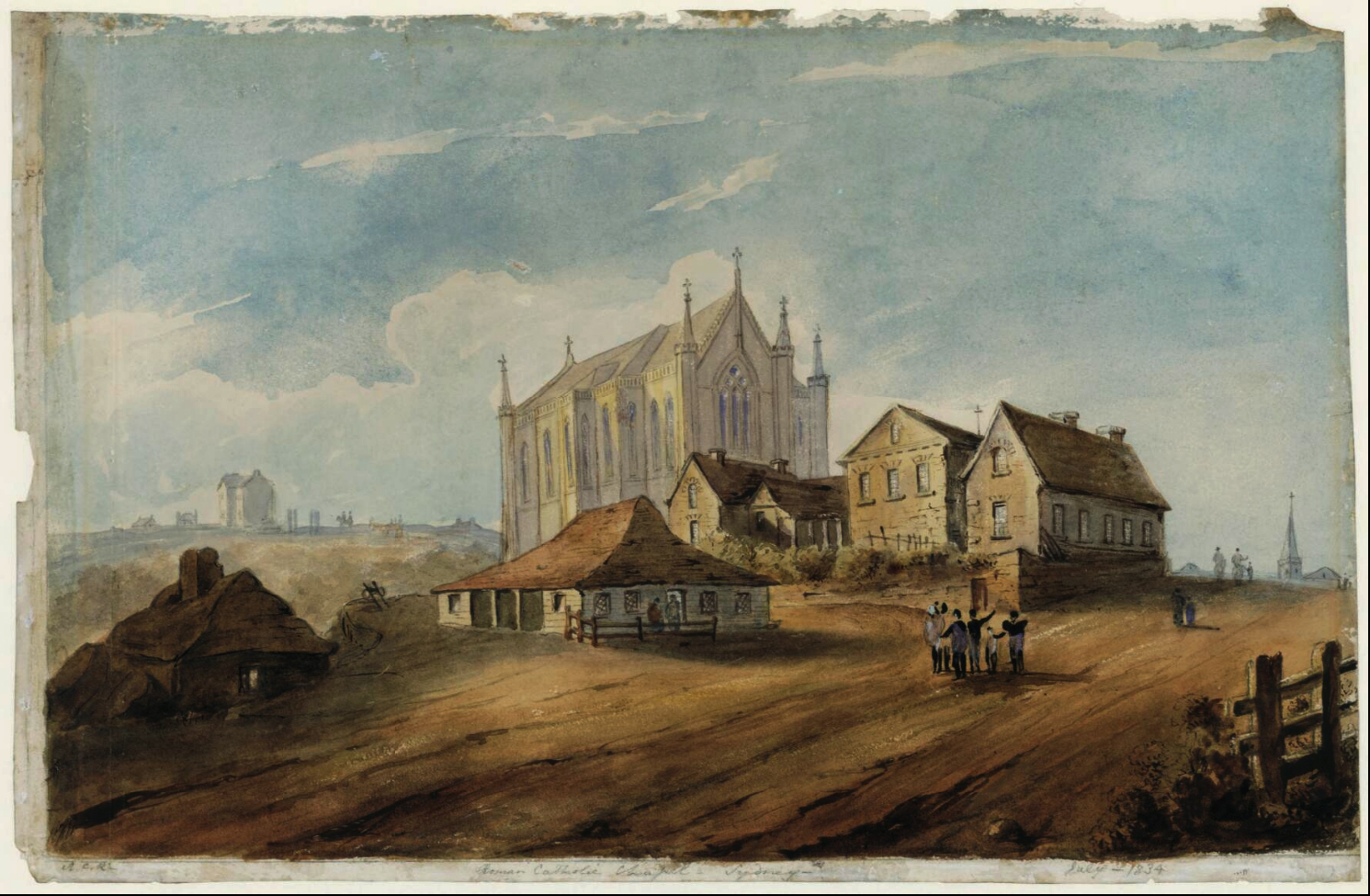
Standing on what is now Saint Mary's Road, an artist painted the watercolour shewn above in July 1834, looking towards what we know as the site of the ANZAC Memorial in the southern precinct of Hyde Park.  This watercolour is part of the collection of the National Library of Australia.

In the centre of this painting is Saint Mary's Catholic Chapel, whose exterior walls of light-coloured stone had only been completed in the previous year.  A year later, it would become the Cathedral Church of the newly-arrived Bishop Polding.  The proportions of Saint Mary's are not quite accurately portrayed in this painting : it was of a much more "squat" appearance.

The focus of these paintings is a collection of buildings which were constructed in stages during the 1820s and included a temporary chapel (under the patronage of Saint Joseph), a schoolroom and the residence for the various pioneering priests. 

AMDG


ENDNOTE

EN1  Biographical notes prepared in 1967 by the late Mr Bede Nairn for The Australian Dictionary of Biography were used as the skeleton for this article.


30 March, 2026

Go to the foot of the Cross

Archbishop Polding


If there is one thing more obvious than another in the vocation to which the Almighty has called us Christians, it is its absolute claim over all that man has and is - the entireness of the change by which the Christian has become a new creature, and which old things are passed away, and all things are become new.  Hence, indifference is amongst its deadliest enemies or, rather, it is a foe which bears within itself the concentrated mischief of all others.  Open sin degrades and makes miserable the sinner, but it leaves his with his eyes in some degree open, if it be only to see his own nakedness. ...

The first and the greatest of all commandments – the first of the two on which hang all the law and Prophets, runs thus: “You shall love the Lord your God with your whole heart, and with your whole soul, and with your whole mind.”  Recall to memory the terms which are used by the inspired writers of the New Testament, in order to describe true nature of the life which is to be led by the disciples of Christ : it is a pilgrimage, a race, warfare demanding watchfulness, and endurance, and stout heartedness.  The merchant of our blessed Lord’s parable, having found the one pearl of great price, went his way and sold all that he had, bought it.  If Christian men would be indeed followers of Him whose name they bear, they are warned of the cost as earnestly as they are lovingly invited; they are to take their Cross daily; they are to stand prepared to give up all that is dearest in human life, and that life itself also, when their Master’s call is heard.  The same voice which is ever crying throughout the world “Come to me all you that labour and are burdened, and I will refresh you,” utters also the warning exhortation “You cannot serve God and Mammon” : the same Good Shepherd who gathers the lambs in his arms, and seeks out with so loving a perseverance the wandering sheep, has Himself told us of the day when He will say to those who - at the appointed hour, shall have no oil in their lamps -  “I know you not.”

There is a fearful error, Dearly Beloved, against which no warnings of mine can be too solemn and importunate.  It is the error of supposing the Christian life to be a thing of negatives, as if all you had to hope and strive for were the avoiding of flagrant transgression of the penal laws of God.  What an unworthy distortion of Christian thought, and yet how many seem to adopt and live in this distortion !  You are “to cease to do evil” certainly, but it is that you may “learn to do well” and these two things are as inseparable in practice as they are in precept.  What is the main character of the spirit taught by the Church and by the Holy Scriptures?  Is it not the filial temper of love and self-sacrifice, and devout imitation of our Lord, in very contra-distinction to the grudging, reluctant, sluggish, lukewarm temper of the slave who fulfils an unloved service under constraint and fear of punishment? Think too, again, of that revelation which our Saviour has graciously made to us of the manner in which the last judgement will be conducted.  How much it declares, and how much it implies…. The blessed are blessed for what they have done; the cursed are cursed for what they have left undone.  Most merciful and dread lesson!  Let us take it to heart.

What we have said, Dearly Beloved, and what we have suggested, is enough to guide your thoughts in the direction in which we would in this season have you employ your self-examination.  What is the remedy … if you discover that practical indifference has fastened upon yourselves, or upon any you love and care for?  This one thing; recurrence to one of the first statements of your catechism - man was created in order to know God and serve Him in this world, and to be happy with Him in the next.  Enter into the depths of this truth and when you are in some tolerable measure permeated by a sense of what it implies, then look at this world, at its utmost good and evil in such a light.  Or listen to these words of eternal wisdom: “What shall it profit a man if he gains the whole world and lose his own soul?”  

Better still to go to the foot of the Cross; spend these few days of the penitential season in the slight self-denial that is required of you, strengthen your heart and purge your soul by the spiritual exercises of the Church, and then look up into the face of the Crucified, and see whether you can find any excuse for indifference.  Never did Christian man, as he stood upon Calvary and contemplated its spectacle, think of half measures.  Truly and wholly, in the church and in the world, in prosperity and adversity, “I am yours and yours only, My Lord and my God.”  May this be in all your hearts; and make the grace of our Lord Jesus Christ, and the charity of God, and the communion of the Holy Spirit be with you all.  Amen.


Excerpts from Archbishop Polding's Pastoral Letter for 1860 as contained in the anthology The Eye of Faith.

------------------------------------------------------------------

NOTES

The Eye of Faith was printed by the Lowden Publishing Co., Kilmore Victoria in 1977.  The editors were Gregory Haines, Sister Mary Gregory Foster and Frank Brophy.  Special contribution to the volume were made by Professor Timothy Suttor and James Cardinal Freeman.

AMDG

28 March, 2026

Looking through the Eyes of Faith : 1

Archbishop John Bede Polding
Thanks to the zeal of a previous generation of Church historians, a most important volume was published in 1977, to coincide with the centenary of the death of Archbishop Polding.  

This volume was The Eye of Faith : The Pastoral Letters of John Bede Polding.  Its editors had carefully collated all the Pastoral Letters which Polding had written to the Faithful of the Church in Australia, of which he was bishop, since 1835.  

It is a collection of great value.  

In two marvellous and inspiring essays at the beginning of the volume, the editors describe the significance of these Pastoral Letters.  These are some extracts from the first of those essays :


John Bede Polding’s Pastoral Letters are valuable historical documents. During middle forty years of the nineteenth century, Archbishop Polding wrote some seventy letters on a variety of subjects : education; the care of orphans; hospitals; capital punishment; salacious literature and censorship; world events,  including the Crimean war, the Indian mutiny; the papacy and the Papal States; floods and other very local events; politics, the responsibility of government, social harmony and the monarchy.  A number of them comment on questions which are attractive to present-day historians: aboriginals; family life and the role of women; the wider social life of colonial Australia, rather than its more narrow political expression. §

For the historian, the value of the Polding Letters is enhanced by the acuteness of their observations and comment.  Their author’s sensitivity to the nuances of colonial life - as well as to its obvious aspects - grew out of his belief that religion was a vitally involved with human activity, that each moment of time had an eschatological significance. §

Polding did not observe facts alone, but their implications for people in Australia. Each time he wrote he tried to draw his audience closer to God, to encourage upright human conduct and to counter evil, sin and the false ideologies which challenged God’s presence in Australia.  His letters present a consistently based view of the state of religion and of private and public morals in Australia throughout the crucial years of the nineteenth century. §

As historical documents, these letters present aspects of colonial life which are not often encountered in the writings of politicians, administrators and newspaper correspondents.  They have an underlying unity which derives from the known and consistent attitude of the author and which, in turn, is of assistance to those who are seeking a basis of comparison between one time and another during the forty years which they span. §

The Pastoral Letters of John Bede Polding are the footprints of the Australian Catholic Church’s first apostolic tradition and its best surviving expression.  They comprise a testament of the faith proposed for the Church’s belief; of the hope which sustained its faith and justified its discipline; and of the soul of its life of faith and hope, the doing of the truth in charity.   This deeper value, this bond of greater unity in Polding’s Letters is to be seen by those who read, not as students of one discipline or another, but with the eye of Faith. §

The Polding Pastorals are possibly Australia’s only (though by no means pure), example of a religious literature – and of an implied Christian culture – which was both markedly monastic in character and contemplatives in orientation.  They confronted the activism and unbelief which marked his day and do no less today.  ...

Polding  … and his writings suffer no embarrassment by being numbered with John Henry Newman and his works.

To be continued.

NOTES
The Eye of Faith was printed by the Lowden Publishing Co., Kilmore Victoria in 1977.  The editors were Gregory Haines, Sister Mary Gregory Foster and Frank Brophy.  Special contribution to the volume were made by Professor Timothy Suttor and James Cardinal Freeman.


AMDG


25 March, 2026

NEW PORTRAIT OF ARCHBISHOP POLDING

On this beautiful Feast of the Annunciation, we are pleased to release this new portrait of Archbishop Polding.


Archbishop Polding


This digital image has been prepared for a new printing of the memorial card of Archbishop Polding which has been in distribution since 2019. 

The new portrait, created by The Saint Bede Studio is a good likeness of the Archbishop and is based on a photograph taken of him around the year 1860 when he was in his mid-50s.  This image was prepared by digitally recreating the old photograph with careful attention to detail, whilst adding new features, such as the background.  This is not a click-of-a-button AI image.

The memorial card will continue to be distributed to Parishes in the Archdiocese of Sydney (and beyond) as we prepare for the Sesqui-centenary of the Archbishop's death in March 2027.

AMDG.

11 April, 2025

Portrait of Archbishop Polding


Archbishop Polding

The Most Reverend John Bede Polding OSB

1794-1877

Vicar Apostolic of New Holland 1835 -1841

Archbishop of Sydney 1841 - 1877

Born in Liverpool UK

Died in Darlinghurst NSW

Buried in the crypt of Saint Mary's Cathedral Sydney.


That in all things God may be glorified.


Image created by the Saint Bede Studio 2022 based on an engraving from the 1850s.

17 December, 2023

A Pastoral Letter for Advent by Archbishop Polding : 1856


The Holy Season of Advent, which commences this day, has been instituted to dispose the faithful to celebrate with proper sentiments the feast of Christmas.   Sorrow for sin : atonement for it by prayer and penitential exercises, in union with all our dear Saviour suffered for our sins; meditation on the Incarnation of the Son of God; [these] are specially recommended and enjoined by the Church, as suitable for this holy time.   It is therefore a Lent, mitigated in form, and shortened in its duration, during which, gratitude for the first coming of Jesus in the flesh, a great desire of His coming and taking possession of your hearts; a preparation for His third coming in great power and majesty to judge the world; these dispositions ought to influence us to amendment and holiness of life.


First, never let us forget the deplorable state from which the Blessed Son of God, by becoming man, has delivered us.  He has opened for us the kingdom of Heaven; He has obtained for us and granted us the means of rising out of the abyss of sin; He has redeemed us from a most cruel bondage.  He is our Saviour.   O, can we reflect on all that He has done and suffered for us, unmoved by feelings of profound gratitude?  Whilst yet in His Mother’s sacred womb let us unite ourselves with her in adoring, in thanking Him with all the affection of a devout and grateful heart.  And for this purpose, let us be assiduous and exact in reciting three times a day the Angelus, a short an excellent exercise of piety, instituted to keep before the mind of the faithful the remembrance of the Incarnation of the Son of God.

A second disposition for this holy time, is to have a great desire for Jesus Christ to be in possession of our souls.  This is the case when his grace is our spiritual life, and his spirit is the animating principle of our conduct. “If anyone love me” He says “the Father will love him, and we will come to him and abide with him.”  Entertain, therefore, a strong desire to be thus united and made one with your Saviour; and as it is impossible for an affection for sin and the love for Jesus Christ to exist in the same soul, hate and detest sin as the greatest of all evils and use the means appointed to be delivered from it.  Prepare to make a good Confession.  Invite your Saviour to come to you in Holy Communion …. Desire with a strong desire to eat the Pasch with your Saviour.  He is our wisdom.  He is our light.  He is our life.  Come then sweet Jesus, delay not! sin in our hearts shall be destroyed, and thou alone shall reign therein.

A third disposition proceeding from the consideration of the third coming of Jesus Christ in judgement, is to have a deep regret for our sins, and in earnest desire to do penance for them.  To inspire us with this disposition the Church brings before our minds on the first Sunday of Advent, the description of that judgement.  For the same reason she, on other Sundays of Advent, addresses to her children the admonitions John the Baptist gave the Jews: “Do penance” said he “the kingdom of heaven is at hand. The axe is already at the root of the tree - every tree which brings forth not good fruit, shall be cut down and cast into the fire. Prepare you the way of the Lord, make straight his path, and all flesh shall see the salvation of God.”  Moved by these admonitions, the faithful from the earliest times, consecrated the four weeks preceding Christmas to fasting and to prayer.

Excerpts from Bishop John Bede Polding's Pastoral Letter published 30th November 1856 as contained in the anthology The Eye of Faith.

AMDG

NOTES
The Eye of Faith was printed by the Lowden Publishing Co., Kilmore Victoria in 1977.  The editors were Gregory Haines, Sister Mary Gregory Foster and Frank Brophy.  Special contribution to the volume were made by Professor Timothy Suttor and James Cardinal Freeman.

19 June, 2023

Looking through the eyes of Faith : 2 [re-posted]

Over a period of years, we hope to publish on this blog extracts from Archbishop Polding's Pastoral Letters, as published in The Eye of Faith : The Pastoral Letters of John Bede Polding.  The editors of this important volume had carefully collated all the Pastoral Letters which J B Polding had written to the Faithful of the Church in Australia, of which he was bishop, since 1835. 

In this post, we continue with extracts from an essay which acts as a preface to this volume.


In diebus illis
Archbishop Polding in 1869.
Image : State Library of NSW.
In Polding’s day, in the Church in the New World, the pastoral letter resumed something of the role and importance which its forerunners had in the early Church. In the United States and Australia, clergy were scarce and Catholics were in a minority. In each place, people from different cultural backgrounds were thrown together and were faced not only with the challenge of being pioneers in a new land, but also that of building new human and religious communities. In the case of Australia, there was the additional strangeness of the southern hemisphere and the worn, strange nature of the continent itself. 
§

In his Pastorals, Polding developed his themes after the manner of the early bishops and monastic leaders, the Fathers of the Church. His Benedictine formation ensured that the first foundation of his thought would be the Scriptures and their writings. … He was primarily a spiritual man, one who read Scripture with the eye of Faith. 

The Polding Pastorals are possibly Australia’s only (though by no means pure), example of a religious literature – and of an implied Christian culture – which was both markedly monastic in character and contemplatives in orientation. They confronted the activism and unbelief which marked his day (and do no less today). §

His monastic tradition and formation gave Polding the special aptitude to grasp the Pauline doctrines of the Body of Christ and a spiritual fatherhood. § [They] also gave him his compassionate understanding of the needs of convicts and aboriginals, an understanding which was never patronising. 

Most of Polding’s direct quotations came from the scriptural texts then most commonly employed by the liturgy … As a teacher, as well as one who had learnt in this school, he placed great value on the liturgy. He tried to make it a feature of the Australian Church, even to the public recitation of vespers during his visits to country stations. However, his best use of the Bible was not by quotation or as a basis for apologetics. It was when he savoured the Word of God that Polding’s thought was richest and his exhortations most telling. 

Polding’s liturgical formation gave him a sensus fidelium which enabled him, when he had the leisure, to ramble with delight and sureness through the whole field of the Scriptures. This it was which gave to his best teaching the charm of poetry and, to his exhortations, direct access to men’s hearts. 

This use of Scripture helped Polding to speak directly to his audience. It amounted to a form of teaching which flowed from a life of a prayer and which attempted to arouse in his people of desire for God and the things of God. In its subordinate parts, it presented values other than those materialistic and hedonistic ones which produced inhumanity, the crude brutality of the early colony and the refined cruelty which was taken its place. It took account of the fact that early Australia failed to support little more than a misconstrued old Testament religion – harsh justice, the thriving of the mighty and the lamentations of the weak, many of whom lapsed into that petty iniquity which their little means could afford. According to one observer, those many Catholics who had abandoned the religion had also erected proud barriers protect to protect either the success or their shabby iniquities. Polding deplored this but he seldom confronted the miscreant with the imprecations of church law. Rather, he sought to reach people with the immediacy of the Scriptures, to speak to their hearts and thus encourage them to overcome their pride or their lassitude. 

As a whole, Polding’s teaching aimed to bring a Christian culture to Australia, an integration of the ordinary and extraordinary elements of human life with its most sublime possibilities. He sought to bring to the young church in Australia a contemporary form of that monastic and Christian culture which had inspired medieval Europe. That this grand plan did not find full life, as its model had not found constant, living expression, save as an ideal, destroyed neither the value of Polding’s teaching nor the wisdom of striving to establish an inspiring religious culture in Australia. § 

As the interior of the old continent [of Australia] demands timeless youth, Polding knew how to start afresh. He faced fire, and flood, and dry rot, and disease and yet he continued. He fought for his foundation as a pioneer, in the face of the elements, had to fight for his flock and herds, his crops and his homestead. And when the occasion demanded a fierce fight he could be as a young David facing his Goliath. §

In his determination, Polding showed the young virtue, hope. In his labours, which continued almost until the sun had set, he acknowledged that, as they were from him, his works were impermanent; [yet] as requested by God, by his office as a founder- bishop, they were somehow necessary. The sympathy between Polding and Australia gave a special attraction to the teaching which was required of him. He wrote of spiritual freedom in a land of penal origin. To a land mostly desert, he brought the seeds of a new and satisfying spiritual fruit. His pastoral letters present the gospel truth which sets men free. They present this truth in ways which invite and show men how to live in brotherhood. They brought wisdom to a fertile desert land, to a place which, it has seemed to eyes blind to faith, God forgot.

NOTES
The Eye of Faith was printed by the Lowden Publishing Co., Kilmore Victoria in 1977.  The editors were Gregory Haines, Sister Mary Gregory Foster and Frank Brophy.  Special contribution to the volume were made by Professor Timothy Suttor and James Cardinal Freeman.

The engraving of Archbishop Polding was published at the time of his death, but was based on a photograph taken in Melbourne in 1869.  In it, the Archbishop is wearing a cope and mitre which were not his, but belonged to the Bishop of Melbourne, James Alipius Goold OSA.  The mitre was designed by AWN Pugin.

14 June, 2023

Looking through the eyes of Faith : 1 [reposted]

In diebus illis
The newly-consecrated Bishop Polding OSB in 1834.
Image : State Library of NSW.
Thanks to the zeal of a previous generation of Church historians, a most important volume was published in 1977, to coincide with the centenary of the death of Archbishop Polding.  This volume was The Eye of Faith : The Pastoral Letters of John Bede Polding.  Its editors had carefully collated all the Pastoral Letters which Polding had written to the Faithful of the Church in Australia, of which he was bishop, since 1835.  It is a collection of great value.  In two marvellous and inspiring essays at the beginning of the volume, the editors describe the significance of these Pastoral Letters.  Extracts from these essays will be published at this blog over the following weeks.  These are some extracts from the first of those essays :


John Bede Polding’s Pastoral Letters are valuable historical documents. During middle forty years of the nineteenth century, Archbishop Polding wrote some seventy letters on a variety of subjects : education; the care of orphans; hospitals; capital punishment; salacious literature and censorship; world events,  including the Crimean war, the Indian mutiny; the papacy and the Papal States; floods and other very local events; politics, the responsibility of government, social harmony and the monarchy.  A number of them comment on questions which are attractive to present-day historians: aboriginals; family life and the role of women; the wider social life of colonial Australia, rather than its more narrow political expression. §

For the historian, the value of the Polding Letters is enhanced by the acuteness of their observations and comment.  Their author’s sensitivity to the nuances of colonial life - as well as to its obvious aspects - grew out of his belief that religion was a vitally involved with human activity, that each moment of time had an eschatological significance. §

Polding did not observe facts alone, but their implications for people in Australia. Each time he wrote he tried to draw his audience closer to God, to encourage upright human conduct and to counter evil, sin and the false ideologies which challenged God’s presence in Australia.  His letters present a consistently based view of the state of religion and of private and public morals in Australia throughout the crucial years of the nineteenth century. §

As historical documents, these letters present aspects of colonial life which are not often encountered in the writings of politicians, administrators and newspaper correspondents.  They have an underlying unity which derives from the known and consistent attitude of the author and which, in turn, is of assistance to those who are seeking a basis of comparison between one time and another during the forty years which they span. §

The Pastoral Letters of John Bede Polding are the footprints of the Australian Catholic Church’s first apostolic tradition and its best surviving expression.  They comprise a testament of the faith proposed for the Church’s belief; of the hope which sustained its faith and justified its discipline; and of the soul of its life of faith and hope, the doing of the truth in charity.   This deeper value, this bond of greater unity in Polding’s Letters is to be seen by those who read, not as students of one discipline or another, but with the eye of Faith. §

The Polding Pastorals are possibly Australia’s only (though by no means pure), example of a religious literature – and of an implied Christian culture – which was both markedly monastic in character and contemplatives in orientation.  They confronted the activism and unbelief which marked his day and do no less today.  ...

Polding  … and his writings suffer no embarrassment by being numbered with John Henry Newman and his works.

To be continued.

NOTES
The Eye of Faith was printed by the Lowden Publishing Co., Kilmore Victoria in 1977.  The editors were Gregory Haines, Sister Mary Gregory Foster and Frank Brophy.  Special contribution to the volume were made by Professor Timothy Suttor and James Cardinal Freeman.

This, the earliest known illustration of John Bede Polding, was painted at Downside Abbey shortly after his consecration as a bishop in 1834 and before his voyage to Australia.  This image was digitally enhanced from an old photograph made of the painting many years ago.

AMDG


30 April, 2023

"In Those Dayes" Australian Catholic History blog

The Latin words In diebus illis are translated as "in those days" and we have chosen them as a title for this blog which presents Australian Catholic history.  Although primarily concerned with detailing the life of our first Christian bishop, John Bede Polding O.S.B., we also present articles about various aspects of the history of the Church in Australia in the nineteenth century.

The following are some articles which you might find interesting :

Catholics and the First Fleet.   

The beginnings of Catholicism in Australia 1792 - 1834

The La Perouse Mysteries

The Founding of old Saint Mary's Cathedral 1821

Biography of Archbishop Polding


Our project to promote interest in the life and work of Archbishop Polding is being blessed by good numbers of visitors to our Facebook page and blog.  We are discovering that interest in Archbishop Polding is not confined to Australia, but that there are "followers" overseas, particularly in England and Europe.

Archbishop Polding
Archbishop Polding OSB

It is so wonderful to learn of the esteem in which the Archbishop is held even by those beyond these shores.

As our project continues, we find ourselves in need of support from those of you following this work.  We need support in planning events (such as the annual Polding pilgrimage), help in distributing promotional material about the Archbishop, assistance with our ongoing research work and other general assistance.

Perhaps you have some time to assist?  Perhaps you have already studied Catholic history in Australia and would like to help make it better known? Perhaps you are retired with more free time and have an interest in Archbishop Polding?  Perhaps you are interested in history or genealogy and are familiar with historical research?  Perhaps you have experience in organising religious gatherings? Perhaps you have secretarial skills?  Perhaps you are young and enthusiastic?

Would you consider offering assistance?

We can be contacted at this e-mail address or via our Facebook page.


AMDG


15 March, 2023

Lenten Pastoral of Archbishop Polding for 1852

Archbishop Polding

Remember man that dust thou art and into dust thou shalt return ... In all thy works remember thy last end,· and thou shalt never sin ... With desolation is all the land made desolate: because there is none that considereth in the heart.  [1]

These, Dearly Beloved in Jesus Christ, are admonitions which, at all times, but more especially at the present season, and in our present circumstances, merit our serious attention. For we require all the aids which reason and revelation offer to us, in order to be enabled to maintain our souls in simplicity before God, and to keep out of them those unruly desires which worldly prosperity, or the expectation of it, is too apt to excite : desires, which war against our peace, and destroy all concern for our eternal welfare. May the Holy season we commence prove to us the Days of Salvation, by recalling our thoughts to the one thing necessary.

How instructive is the ceremony with which our Holy Mother the Church opens the penitential offices of this time! On our humbled foreheads, she inscribes in ashes, fit emblem of our mortality, these words : Remember man that thou art dust and into dust thou shalt return. Year after year, this solemn admonition has been delivered to you; year after year, has it been addressed to each of you individually; year after year has the remembrance of this admonition vanished from your minds, almost before the ashes sprinkled upon your heads have ceased to appear.

We feel, Dearly Beloved, that we are particularly called upon in our present circumstances, to remind you of your mortality, and to warn you lest you stumble on the very edge of a precipice; our love for you, and our solicitude for your welfare, compel us to endeavour to draw you from a position of peril. We wish to arouse you from a state of indifference, or to guard you against falling into it, by a consideration of the last end of man: Death, Judgment, Heaven, Hell, and Eternity! These, are the awful realities of our existence, to which we are hastening rapidly; and we announce them, not to inspire terror and dismay, but rather hope and consolation, for the Church assures us this is the acceptable time - the days of Salvation, when the Lord is prepared to dissemble our iniquities, that he may spare. May these truths make the good more fervent, may they determine the sinner to renounce all impiety, to live soberly, justly, and piously, so that he also may expect the blessed hope and meeting of our Lord Jesus Christ !

With sin, came Death into the world; it is appointed that all men shall die: to this decree we must all sooner or later bow .... Each day's experience testifies that, in the words of Holy Job : “Man born of a woman, living for a short time, is full of miseries ... He comes forth like a flower, and is destroyed, and flees as a shadow;·his days are short, the number of his months is with you: you have appointed his bounds which cannot be passed.” [2]

And alas ! there are those who from the shortness of life, draw an argument to justify their criminal indulgence of sensual desires ... But no ! [such persons] cannot close their eyes to the light which revelation imparts; they cannot be deaf to the voice of all nations, and tribes, and tongues; they cannot resist the impulse of their own feelings; they cannot imagine that a God, infinite in justice and in goodness, has created us, and endowed us to no purpose with faculties aspiring to a perfectibility in this life not to be obtained; that He has ordained an order of things in which vice is seen to triumph; and virtue, conjoined with want and wretchedness, is so frequently calumniated and despised. The sufferings and steadfastness of the just will receive their recompense; the crimes of the wicked their condign punishment : God shall judge the righteous and the wicked, for there is a time for every purpose, and for every work.

When the thread of life, at the appointed time, shall be dissevered, the soul, released from its earthly tenement which shall quickly speed to decay, will return to Him who created it: to render an account of the things done in the flesh and to receive retribution according to its works. And, hence, Dearly Beloved in Jesus Christ, the death of the sinner is said to be very evil, followed by a condemnation to the second death which the inspired Apostle describes in these awful words: “The lake of fire is the second death, the fearful, and unbelieving, and the abominable, and murderers, and fornicators, and sorcerers, and idolators, and all liars, their portion shall be in the pool burning with fire and brimstone, which is the second death.” [3]

On the other hand, how different the death of the just! Over these that second death will have no dominion, hence it is written : “ Blessed are the dead who die in the Lord; they rest from their labours and their works follow them.”  [4]  And the God of all virtue awaits their coming that he may bestow the promised recompense. Whilst those who have done evil shall indeed be raised in the body, but it will be the resurrection of condemnation; the material part of the just, “sown in corruption shall rise in incorruption; sown in dishonour shall rise in glory.”  [5]  In the meanwhile, “the souls of the just are in the hands of God, and the torment of death shall not approach unto them. They shall be inebriated with the plenty of your house: and you shall make them drink of the torrent of your pleasure. For with you is the fountain of life."  [6]  ... Associated with the angels and with the good of all ages, in canticles of jubilation, they will celebrate eternally their happiness, their gratitude : “Alleluia! the Lord God omnipotent reigns … Let us be glad, and rejoice, and give glory to him, for the marriage of the lamb is come. "  [7]  Thus is expressed the mysterious union of the beatified soul with its Creator, through Jesus Christ, the end of her being, the consummation of her redemption, the completion of her sanctification.

Oh ye! who are yet in the dawn of life, prepare for yourselves a place amongst the blessed. Then will you experience that it is good for a man to have borne the yoke of the Lord from his youth. 

And you, who are advanced in life, whose pilgrimage must be in order of nature, shortly terminate, prepare for the awful change; render your old age venerable by your virtues. So live, Parents, that amidst the sorrows of your children there may be joy. May the recollection of the spotless tenor of your lives, of your continual good example, of your faithful discharge of all your duties to God, of your integrity in all your dealings, of your assiduous attention to all the exercises of your Religion - be to them a comfort, when comfort they most need.

Dearly Beloved in Christ. If you desire to die the death of the just, live the life of the just. “Fear not,” says Saint Augustine, “he who lives in the Grace of God will die in the Grace of God.”   On the other hand, Saint Jerome declares his conviction, “that of those who lead an habitually evil life - very few sincerely repent and obtain mercy.”  How many are taken away suddenly! How many defer till too late! How many are prevented by circumstances from obtaining the attendance of the Sacred Ministry, and the aid of the ordinary means instituted by Jesus Christ to convey the merits of his Passion to the soul!

O ye! Dearly Beloved in Jesus Christ, who study to live well, that you may die the death of the just, during this holy Time increase in piety, in fervour, in all good. Trim your lamps and with the prudent Virgins await the coming of your Lord “Behold, says he, I come quickly and my reward is with me. He that is righteous, let him be more righteous. And he that is holy, let him become more holy ... Behold I come quickly and my reward is with me, to render every man according to his works.” [8]

And in conclusion, we address ourselves in all fatherly solicitude to you, Dearly Beloved, who have lived long in habits of sin, in indifference, in the neglect of the ordinances of your Holy Religion : Do not, we entreat you, continue in a state which renders all that your Saviour has suffered for you, all the divine inspirations, fruitless and useless in your regard.  Determine to commence with this holy season, a new life : Do not, by systematic contempt of the abstinences and fasts, of the retirement and spiritual exercises of this penitential time, deprive yourselves of the grace so abundantly poured forth, and thus perhaps fill up the measure of your iniquities.  Follow the injunction of your Saviour : Enter into your chambers, close the door, that is, in secret commune with your own soul, alone in the presence of God; and say in the words of St Augustine : “Tomorrow, perchance today, I may be of the number of the dead, and how shall I appear before thee, my God! " 

Having thus judged yourselves, Dearly Beloved in Jesus Christ, at once go, like the Prodigal Son, to your loving Father, who has so long awaited your return; purify your consciences, by an humble avowal of your transgressions and omission; take up with courage the Cross of the Lord; fulfil the duties of this holy time; repair all wrong done as far as in you lies; merit by the sincerity of your repentance to be forgiven, to be made partakers of the Holy Communion, of the Heavenly food which nourishes the soul unto eternal life; dead to sin, live to God, and may He in his infinite goodness enable you to persevere, and crown all his merits in your regard, by granting you the inestimable favour of dying in his love.

Now, may our Lord Jesus Christ himself, and God the Father, who has loved us and has given us everlasting consolation and good hope in grace, exhort your hearts and confirm you in every good work and deed, that, made worthy of your vocation, the name of our Lord Jesus Christ be glorified in you and you in Him.  And may the Grace of our Lord Jesus Christ be with you all.  Amen.

NOTES

1.  C.f. Book of Genesis 3 : 19 and The Prophet Jeremiah 12 : 11. 
2.  The  Prophet Job 14 : 1 - 5 
3.   Book of Revelation 21 : 8   
4.   Book of Revelation 14 : 13 
5.   1st letter of Saint Paul to the Corinthians 15 : 42 
6.   Book of Wisdom 3 : 1 and Psalm 36 : 8 
7.   Book of Revelation 19 : 6 - 7.  
8.   Book of Revelation 22 : 12 


-------------------------------------------------------------------------------------------
This post is an edited extract from the Pastoral Letter for Lent 1852 written by Archbishop Polding and his coadjutor Bishop Charles Henry Davis OSB.  It is reproduced from The Eye of Faith, pp 78-83.  This anthology of the Pastoral  Letters of Archbishop Polding was printed by the Lowden Publishing Co., Kilmore Victoria in 1977.  The editors were Gregory Haines, Sister Mary Gregory Foster and Frank Brophy.  Special contribution to the volume were made by Professor Timothy Suttor and James Cardinal Freeman.

The image of Archbishop Polding is based on a photograph taken circa 1860 and has been digitally enhanced by the Saint Bede Studio.


AMDG